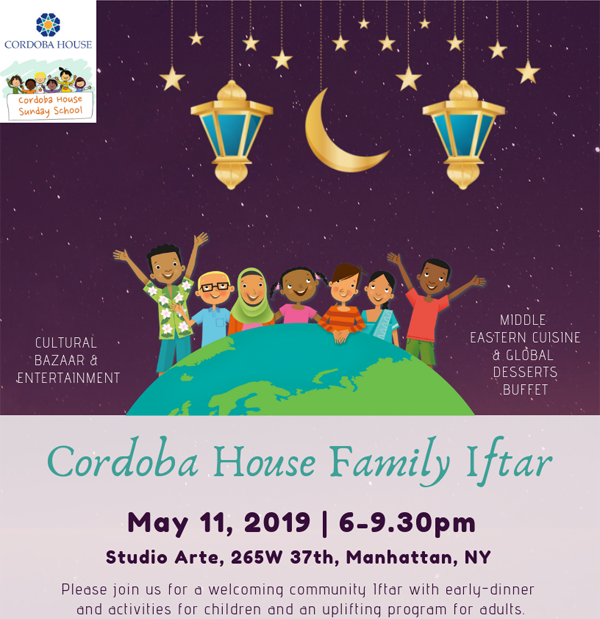
Join Cordoba House for Our Ramadan Family Iftar!
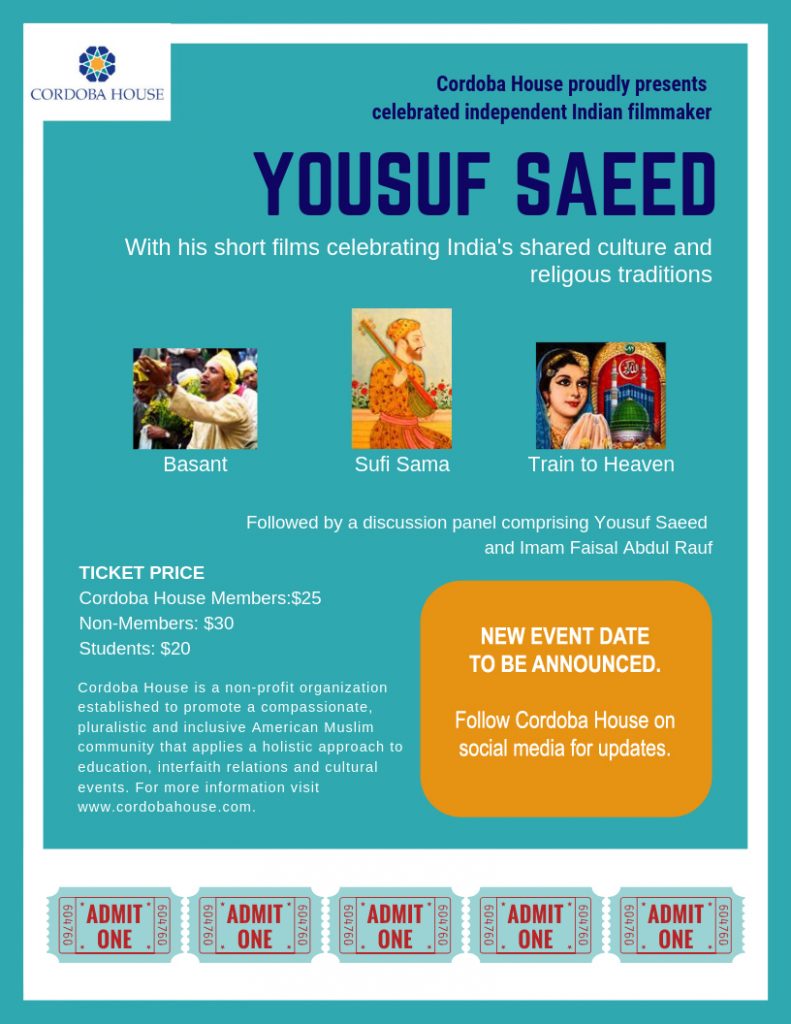
On March 22 at East End Temple, Cordoba House organized a Qawwali event led by the Zaman Zaki Taji Qawwals from Pakistan. The program was part of Cordoba’s overall mission of building a wider bridge of understanding across interfaith groups and creating the emerging Muslim American identity.
Cordoba House Executive Director, Naz Ahmed Georgas, opened the performance with a verse from the holy Quran that emphasizes a commitment to realizing Abraham and Ishmael’s prayers for establishing a community of believers:
Oh our sustainer raise up from the midst of our offspring a messenger from among themselves that who will convey onto them your message and impart onto them revelation as well as wisdom and cause them to grow in purity…
Since Cordoba’s first interaction with East End Temple in 2016, the two institutions have been actively working together to develop joint interfaith programs to bring their two communities together. The alliance first began when Naz Ahmed Georgas was met by the temple’s caretaker, Muhammed, providing a sign of welcome for the work to come.
This most recent Qawwali, in addition to the two prior concerts held at the Brotherhood Synagogue and the Church of St Bartholomew, broke barriers of prejudice by sharing space under what East End Temple Rabbi Josh Stanton describes as the ‘Abrahamic tent.’ These initiatives are examples of how Cordoba House strives to build bridges of trust across communities. On March 22, artists sang of the Divine, “Allah and Adonai,” creating resonance between local Jewish and Muslim communities.
Coming from the word ‘Qual,’ to ‘say,’ Qawwali is a living Sufi practice serving the purpose of realizing the spiritual goals of Islamic mysticism. Quranic text, Hadith, the saying of Sufi masters and poets constitute the verses combined with the Qawwals’ improvisation. Through the ritual of “Zikr Allah,” the naming of remembrance of God, the hearts of the audience awakened like the ‘cut reed longing for its home when it was whole and where it belonged.
PowerPoint Presentation: Download (PPTX File).
[AFG_gallery id=’12’]
Voice of America: NYC Ahmadiyya Muslims Hit with Double Discrimination. Cordoba House Executive Director, Naz Ahmed Georgas, speaks to Voice of America about Cordoba House’s mission of acceptance across lines of faith, both with other faiths and within the Muslim community.
On Sunday, February 25, 2018 Imam Feisal spoke on “Our Common Religious/Spiritual Calling” in conversation with Rabbi Rain Zohav and Rev. Julia Jarvis. The event was hosted by the Interfaith Family Project of Greater Washington (IFFP).
[AFG_gallery id=’10’]
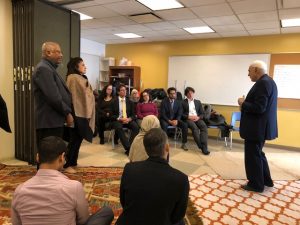 On Friday, February 9, 2018, Imam Feisal delivered his first khutbah at the East End Temple (EET), which has begun hosting Cordoba House Jumu’ah prayers. Cordoba House is actively seeking new khatib participants for this weekly program. The February service followed a class the previous evening at the Temple, taught by Imam Feisal and EET’s spiritual leader Rabbi Josh Stanton, on Jewish-Muslim relations. The rabbi and other members of the synagogue community attended the Jumu’ah service.
Imam Feisal spoke from his vision of a new, multi-faith community of God-believers that promises to emerge from the EET Jumu’ah services. To start, it will be a community of Muslims and Jews. Accordingly, the khutbah embraced both Jews and Muslims in its address, and its call to assimilate into ourselves the presence of God. Cordoba would like to encourage members of the Interfaith community to participate in future Jumu’ah services.
Imam Feisal quoted a hadith of the Prophet Muhammad in which he analogized prayer to bathing in a clear stream: imagine how clean we would be if we bathed five times a day! Similarly, if we bring our full attention to our prayers, we rid ourselves of spiritual stain. Or rather, we make of our prayers a means for God to purify us.
In the end, Imam Feisal reflected, everything comes from God, even our acts. We select from a menu of acts that God supplies. Once we’ve chosen, God energizes those acts into being. It’s really a partnership. And it goes the other way, too. God states in the Quran that He and the angels perform salah on the Prophet, and commands us to also do salah on the Prophet. When we pray, we’re adding our prayer to theirs, since the salah on the Prophet is part of the five-time daily prayer. God also states in the Quran that when we hymn His praises, He does salah on us to exit us out of darkness into light.
Muhammad himself models for our new, multi-faith community. Beyond being Muslim, we’re called to be muminun—believers. That means we’re committed to having iman—faith—in our hearts. And out of faith, mercy, and compassion for each other naturally flow. Like Muhammad, we are to be a mercy to the worlds, beyond our own faith community, beyond even the human community, towards the animals who share the planet with us.
Imam Feisal concluded with thanks to God for the opportunity to begin forming a new multi-faith version of the Cordoba community, and with prayers for blessing on Rabbi Josh Stanton, spiritual leader of EET, and his community. Cordoba House invites more interfaith participants to take part in this weekly Jumu’ah prayer service.
Imam Feisal concluded with thanks to God for the opportunity to begin forming a new multi-faith version of the Cordoba community, and with prayers for blessing on Rabbi Josh Stanton, spiritual leader of EET, and his community.
